Chaosity


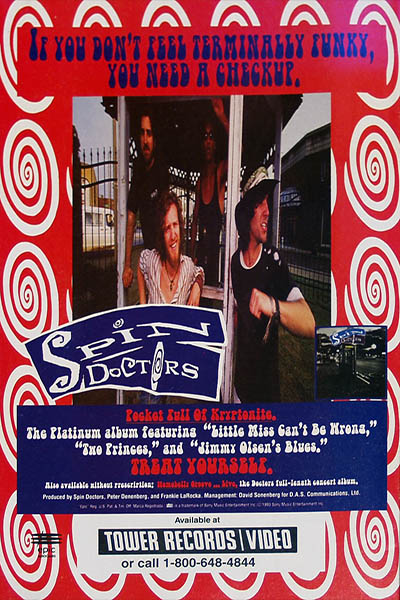 Spin Doctors. They’re a band from the ’80s. You’ve probably never heard of them. They had approximately one hit, in the form of “Two Princes”, which was essentially “Mmm-bop” by Hanson with less sucking and more synthpop. Bonus points for the use of the Bellbottom font, and the phrase “terminally funky”.
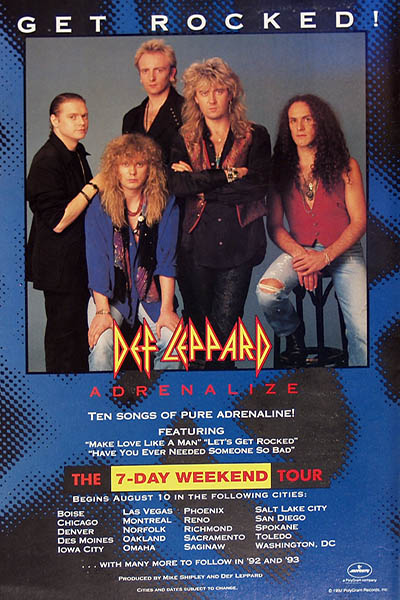
Def Leppard. Possibly the least enthusiastic band ever. Look at them. A funeral is going to break out any second, now.
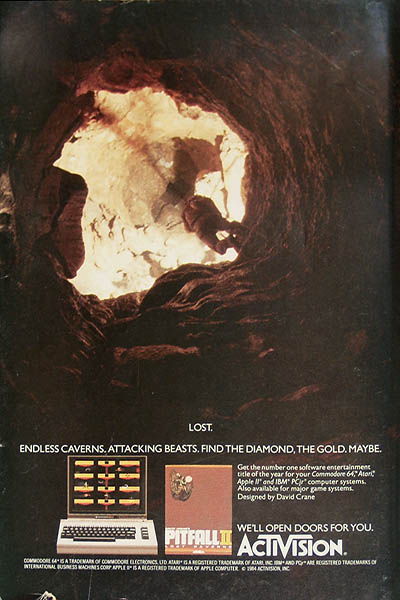 It took some time for me to realise that this was not the image of a gigantic rectal passage. It then took some time for me to realise that despite that, I was still staring up someone’s arse.I never played Pitfall II. I don’t know what to say about it. The computer looks supremely chunky. It practically sports love handles. And the game looks very orange. That is all.
Are you man enough for Megaforce?
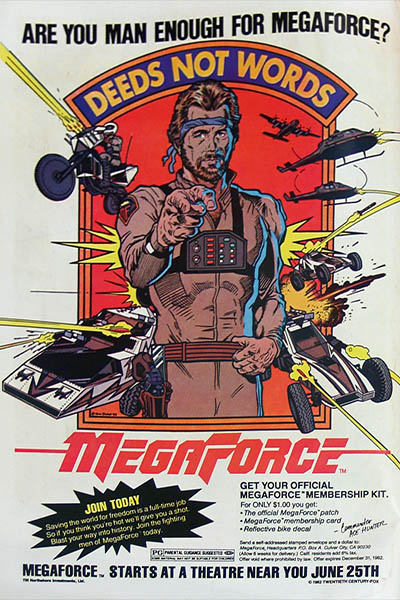
Chuck Norris is. Look at him. There he stands, wearing only a belt and a calculator, not a gonad in sight. Erupting from behind him, a motorcycle with dinnerplate wheels, a decepticon DeLorean blasting whipped cheese from its windshield, a squadron of dune buggies and the entire US Air Force from the Vietnam war. Save up your dollar, you too could be the proud owner of a Megaforce patch, membership card and bike decal. You can proudly display your lack of genitalia, resting assured no one will question your nudity or calculator-laden chest because you’re a card-carrying, patch-weilding member of Megaforce. If anyone questions you, just point at your glistening bike decal and laugh in their faces. Don’t have a bike? Stick it on your DeLorean.
I’ve just finished reading Bill Bryson’s “Mother Tongue”, a reasonably amusing edutainment book exploring the history, complexity and potential future of the English language. All in all, it’s a suitably entertaining read, but I find it’s somewhat flawed by the small issue that factually, it’s probably wildly innacurate. I base this assumption on the various passages devoted to the Australian dialect of the English language, most of which are fundamentally, well, wrong. While I’d like nothing less than to simply reproduce these passages verbatim for your own edification, I have a moral aversion to plagiarism, and shall instead address the various “examples” of Australian speech/grammar/spelling, and then we’ll discuss whether or not anyone ever actually uses them.
Another temptation I shall avoid is the urge to address Mr. Bryson’s quoting from “Lets Talk Strine”, a comedic parody of a book written in 1965 by this bloke, and not representing anything realistic whatsoever about the way anyone did, does, or likely ever will speak.
Anyhow, the actual examples that annoy me:
“Tucker”. This word means “food”. It’s commonly used as part of the term “bush tucker”, and by Australia’s version of rednecks. It’s very quickly disappearing from the language. (And good riddance, say I.)
“Slygrogging.” I have never ever heard this word spoken, nor have I read it prior to seeing it in this book. Apparently (and somewhat evidently, I admit), it defines the act of sneaking out to have a drink. Where I come from, we call that “sneaking out to have a drink”.
“Nong.” A nong is an idiot. No one has used this word since 1987.
“Don’t come the raw prawn with me.” Oh, god. How I both love and loathe this phrase. This alleged common element of Australian parlance, along with various others (”technicolour yawn” for vomit, as cited in this very book is another) survive thrivingly on tea towels and in useless Australian language phrase books. No one ever says them.
Furthermore, the next paragraph in the book proposes a few additional facts that are entirely debatable:
“In Australia, people eat cookies, not biscuits.” No, we don’t. We eat biscuits. Americans eat cookies. If you want to be thoroughly pedantic, we eat cookies when we buy them from Subway.
“They spell many words the American way - labor rather than labour, for instance.” To hell we do. If I’d have spelled the word “labor” in school, I’d have been sorely reprimanded for it, and rightly so. The Australian Labor Party is a vestige of some idiot’s idea of modernising the image of the political party (well, as modernised as it could get in 1912), and is the only time we spell the word without the “u”. As a rule, we follow British spelling conventions, not American conventions. No “-ize” endings, no “-or” endings. And no nukular.
It’s inconsistencies like these that make me doubt the other “facts” presented in the book, particularly when I’m unable to verify them myself and am forced to take them at face value.
I also dislike the easy-to-digest approach when it’s used to present incorrect information, because, frankly, people are more likely to remember rubbish when it’s presented in an amusing format.
I’ve had my whinge. You can all go home now.